Ciudad Entre Aguas
Year: 2025
Site: Atizapán de Zaragoza, Mexico
This project builds upon research conducted by Diane Davis (Charles Dyer Norton Professor of Regional Planning and Urbanism at Harvard GSD), Lorena Bello (PhD, Design Critic of Landscape Architecture at Harvard GSD) , Enrique Lozano (MAUD ‘26), and Cory Page (MUP 25’, MLA ‘25) in Atizapán de Zaragoza, Mexico, in August 2025. Following site visits, meetings with planning officials, and community engagements, the team observed a strong municipal commitment to embedding ecological sensibilities within urban planning. Led by Planning Director Ramón Jarquín, Atizapán’s efforts to map its hydrology, topography, and ecosystems are supporting a shift toward more transparent, data-informed, and environmentally conscious decision-making. These initiatives reflect an aspiration to balance ecological processes with the social, infrastructural, and political dimensions shaping the municipality’s future.
Atizapán’s future plans include its plan to revive “El Centro”—the historic urban core—through pedestrian-oriented design, mobility reform, and revitalized public spaces that restore civic life while reducing dependence on Mexico City. Our “Ciudad Entre Aguas” framework repositions water as both ecological infrastructure and cultural heritage, recalling Atizapán’s origins as the “place upon white waters.” This vision integrates ecological mapping, hydrological restoration, and community participation to imagine an urban identity where water once again structures civic coherence, recreation, and ecological resilience.
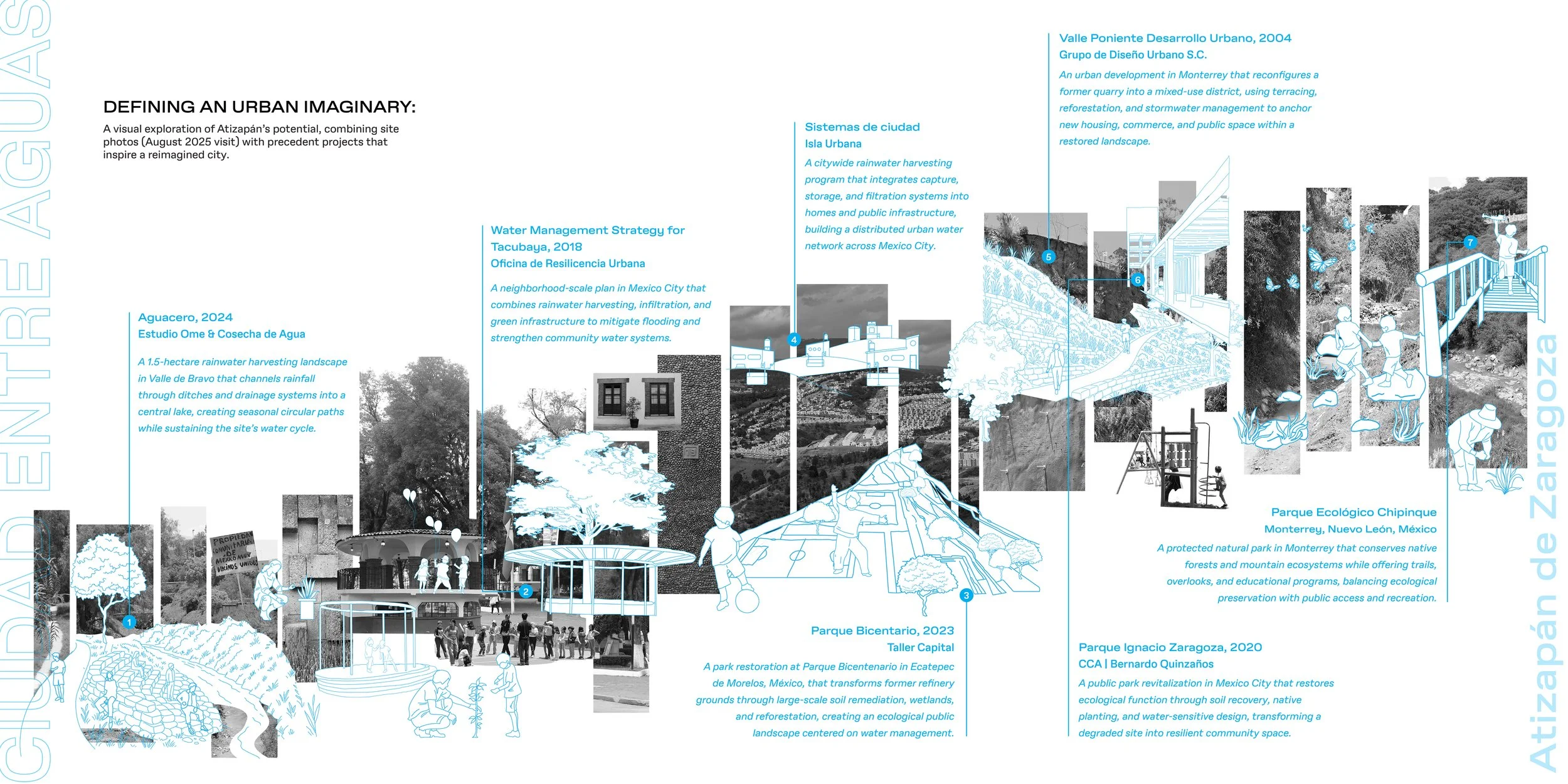
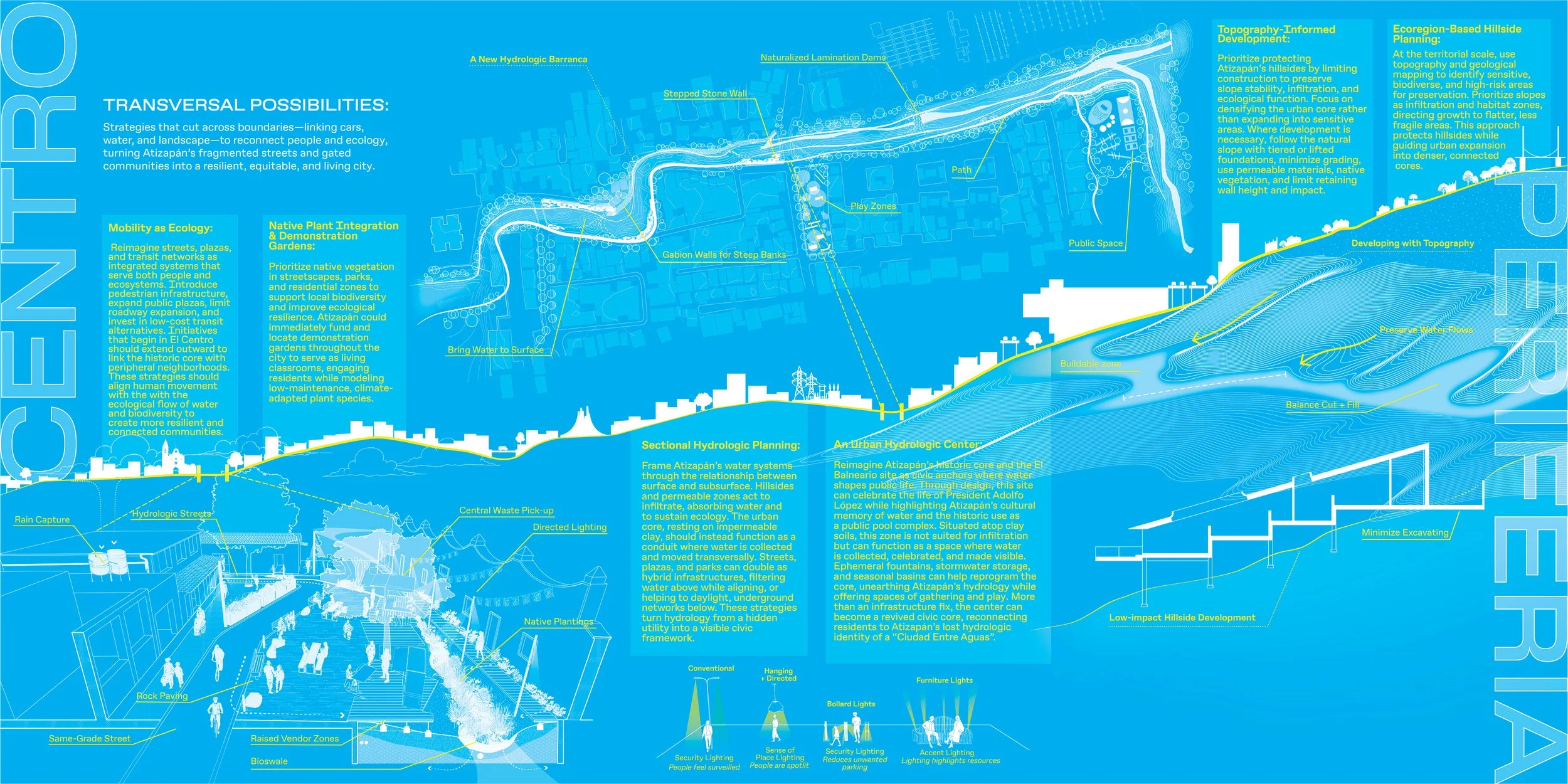
This project takes a “Beyond Binaries” approach, advocating for planning strategies that integrate rather than isolate ecological, social, and temporal systems. Instead of opposing human and natural processes, center and periphery, or past and future, Atizapán can embrace transversal design thinking that connects hydrology, mobility, and civic life. By reimagining the city through a hydro-social lens, the municipality has an opportunity to evolve into a more polycentric, equitable, and resilient urban landscape, one that is as attentive to its ecological flows as to its communities and collective memory.